Human factors methods are only as useful as the form they can be applied in. These are working instruments built out of the research, not demonstrations of it.
Each entry below shows the working interface as it stands. The images are screenshots of running builds, not live demonstrations; the instruments are not deployed here. Validation status is stated for each, and none of them should be read as a validated instrument until its status line says so.
Selected
Sextant — a human factors audit instrument for AI-enabled aviation systems
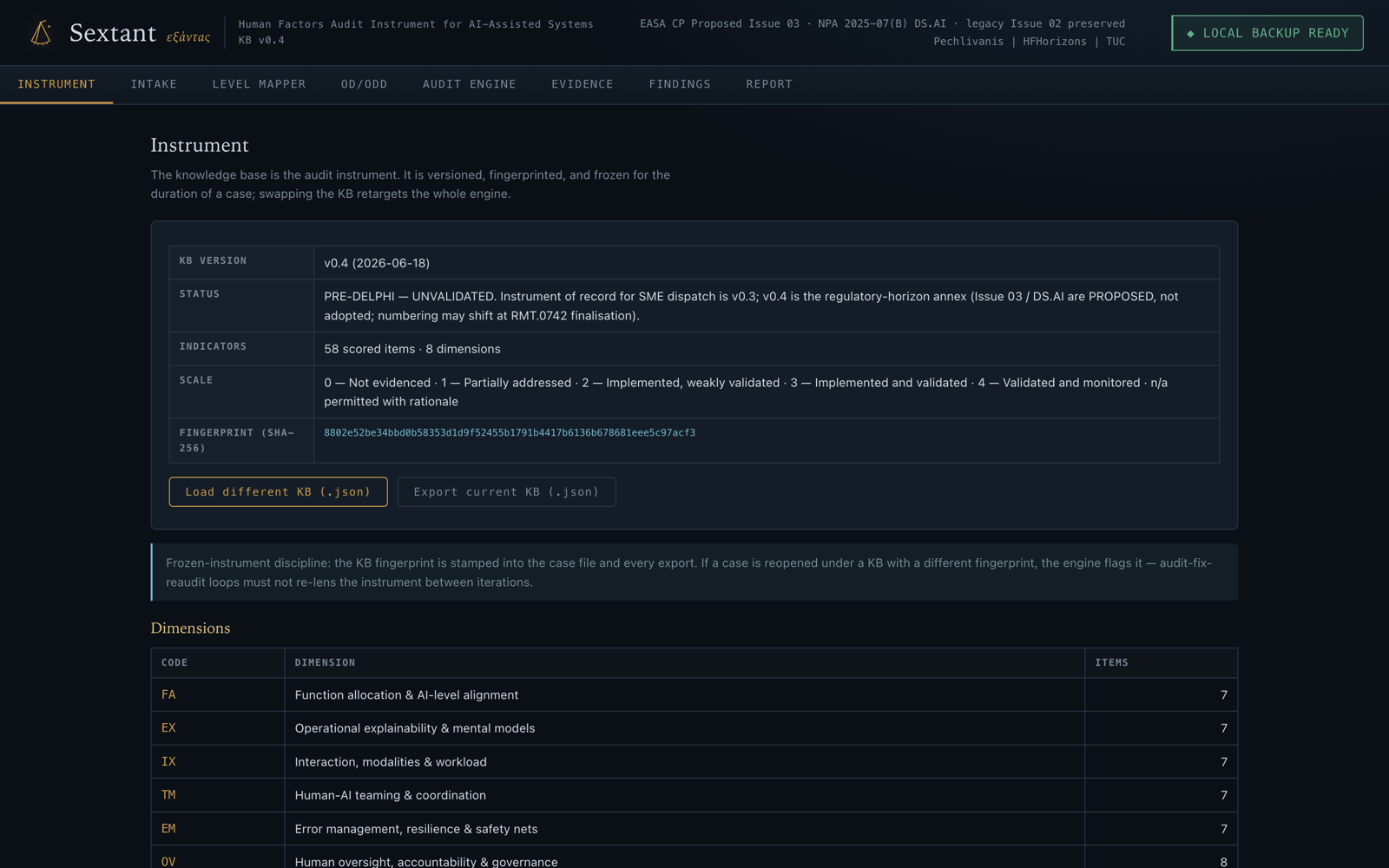
An audit instrument for assessing AI-enabled aviation work systems from a human factors standpoint, anchored to the proposed Issue 03 of the EASA Artificial Intelligence Concept Paper and NPA 2025-07(B) DS.AI, with the Issue 02 mapping preserved. Sixty-three scored items across eight dimensions — function allocation, operational explainability, interaction and workload, human–AI teaming, error management, oversight and governance among them — on a five-point maturity scale from not evidenced to validated and monitored.
The knowledge base is the instrument: it is versioned, fingerprinted with a SHA-256 hash and frozen for the duration of a case, so that reopening a case under a different knowledge base is flagged rather than silently absorbed. Its design is recursive — the instrument is applied to itself, so the audit method is held to the same standard it imposes on what it audits. Maturity scores remain subordinate to narrative findings and are never aggregated into a single figure.
Status: pre-Delphi, unvalidated. Selected in the top ten, EASA AI Olympics 2026.
An auditor's quick guide (v0.1, PDF, ten pages) sets out the method — declaring readiness, scoring against anchors, the justification standard, evidence, findings and what the export records — without reproducing the indicator set. Short link: pechlivanisk.com/sextant-guide.
The instrument itself runs in the browser at pechlivanisk.com/sextant, with the Causalis self-assessment preloaded as a demonstration case. AI assistance on the live page is switched on for events by passcode; without it every judgement, finding and export still works by hand. Audit your own AI application. Declare the system's readiness, answer the three level-mapper questions, and score against the anchors. Nothing you enter leaves your browser unless you switch on the assistant. The instrument is pre-Delphi and unvalidated: what it produces is a structured self-assessment, not a certification finding.
Sextant — the instrument tab, showing the frozen knowledge base, its fingerprint and the dimension set. Select to view full size.
Selected
Causalis — an aviation human factors analyst
A hybrid analytical instrument for accident and incident analysis, pairing a machine first pass with a human-in-the-loop review gate. It supports selection between and application of the established investigation frameworks — HFACS and HFACS-ME, AcciMap, CAST-STPA, FRAM, root cause analysis, task and decision analysis, TEM, SHELL, SRK, TRACEr, PEAR, the Dirty Dozen, SOAM, bow-tie and CAPA — producing coded causal classifications and evidence-based recommendations rather than narrative impressions.
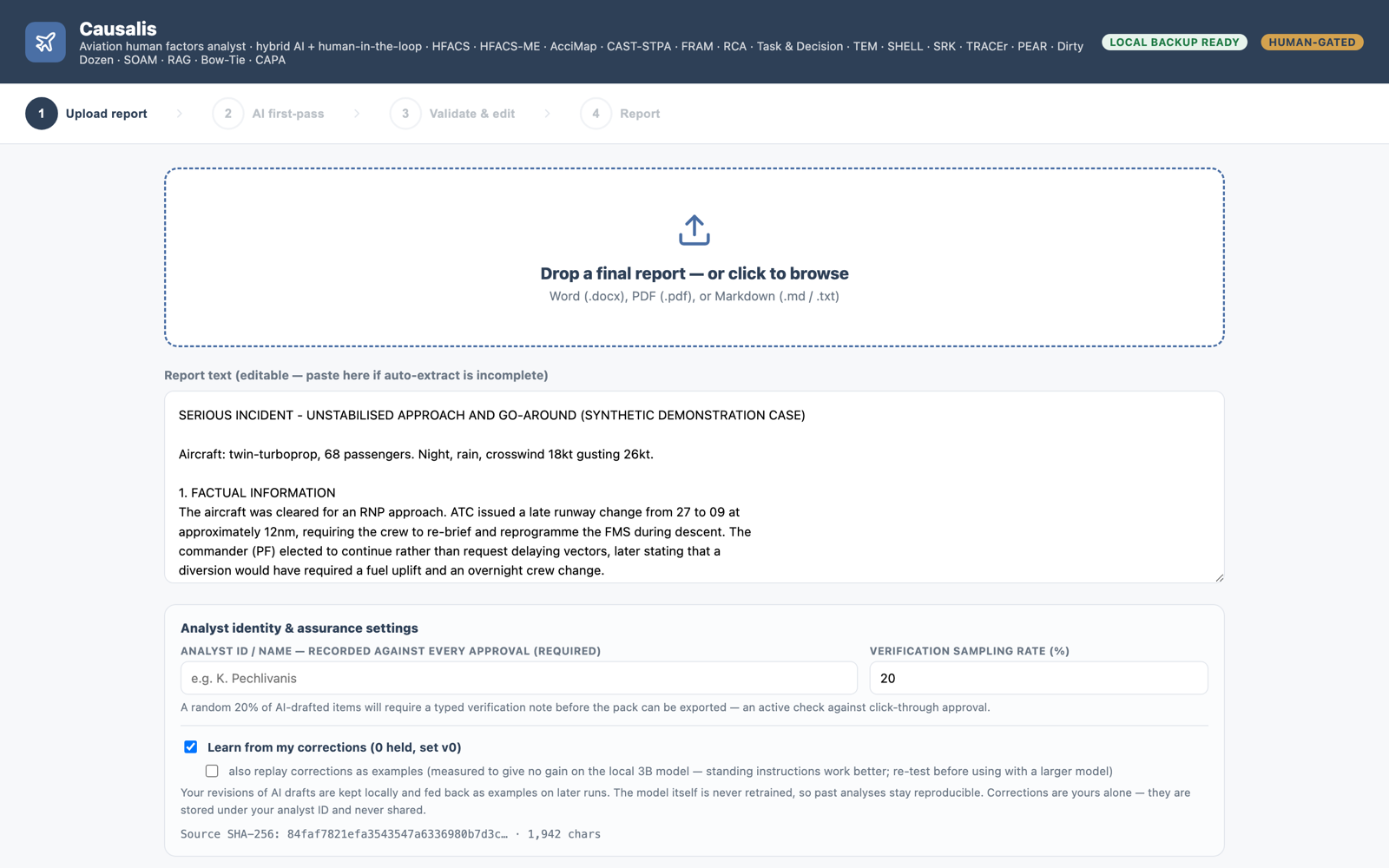
The assurance design is the substantive part. Work moves through four stages — ingest the report, machine first pass, analyst validation and edit, then reporting — and every approval is recorded against a named analyst identifier. A configurable proportion of machine-drafted items, twenty per cent by default, is sampled at random and requires a typed verification note before the pack can be exported, as an active check against click-through approval. Source documents are hashed so that an analysis remains reproducible against the exact text it was drawn from.
Previously listed here as Aviation HF Analyst. Selected in the top ten, EASA AI Olympics 2026.
Causalis — the intake stage with a synthetic demonstration case loaded, showing the analyst identity and verification sampling controls. Select to view full size.
Prototype
ARIA — a serious game for single pilot resource management
A serious-game prototype of the training methods behind the Single Pilot Resource Management conversion course that the doctoral work is building toward. One pilot, one machine teammate, and a teammate that is sometimes right and sometimes wrong without telling the pilot which — the premise the whole exercise turns on. The methods under test are event-based scenarios, trust-calibration feedback and a BARS-band debrief.
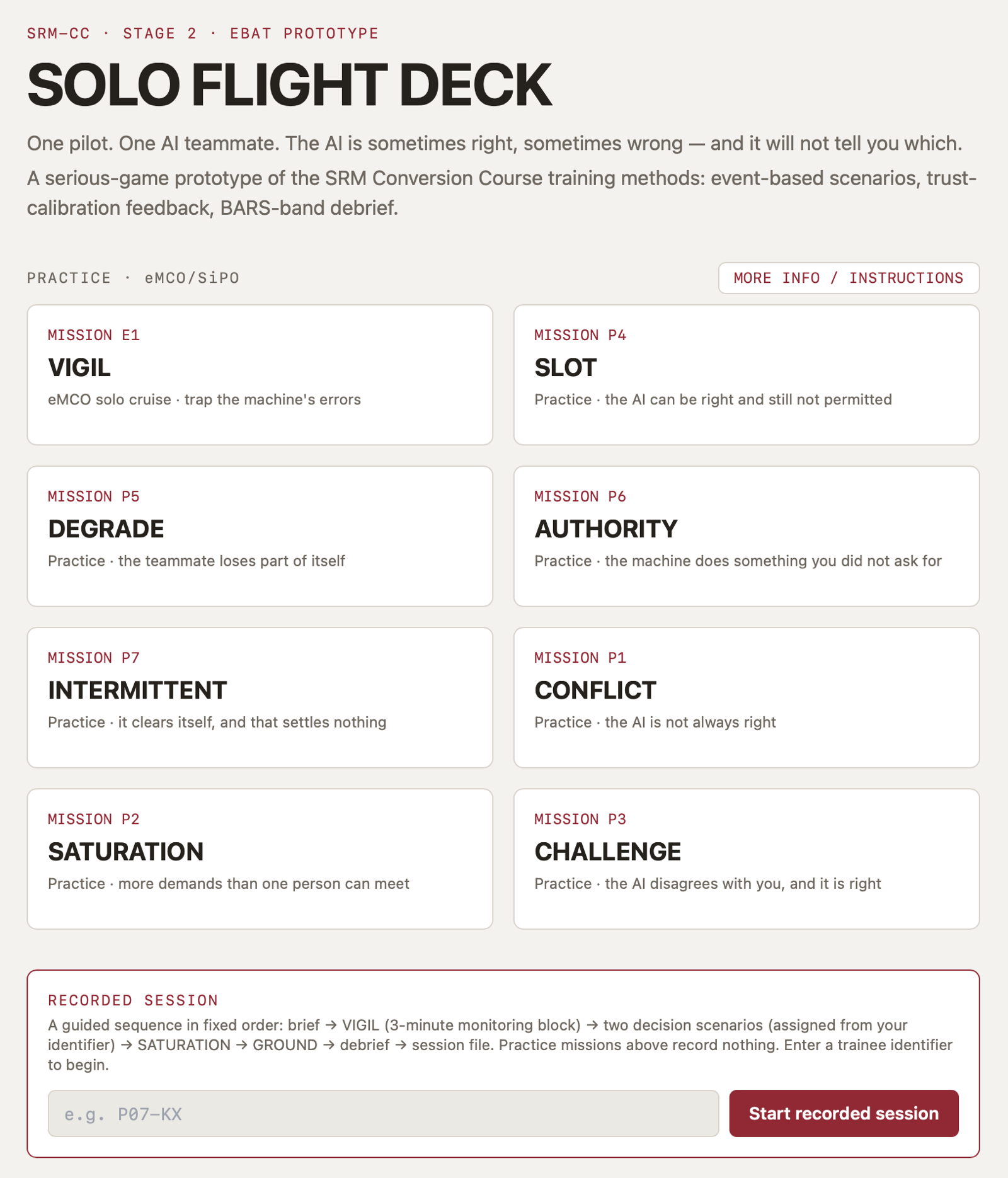
Eight practice missions each isolate a distinct failure mode of human–machine teaming in eMCO and SiPO rather than rehearsing a whole flight: trapping the machine's errors during solo cruise, disagreement where the machine is wrong, disagreement where it is right, a recommendation that is correct but not permitted, a teammate that loses part of itself, an action the pilot did not ask for, a fault that clears itself and settles nothing, and more concurrent demand than one person can meet.
Assessment is separated from practice by construction. Practice missions record nothing at all; a recorded session runs a fixed sequence — brief, a three-minute monitoring block, two decision scenarios assigned from the trainee identifier, a saturation phase, a ground phase, debrief, then a session file. The trainee cannot select which scenarios they are assessed on.
Status: stage 2, EBAT prototype. Previously titled Solo Flight Deck, which the captured interface still carries.
ARIA — the practice mission deck, with the recorded-session panel below it. Select to view full size.
In development
Digital Hangar — scenario generator
A generator for synthetic training scenarios used in competency-based training and assessment, aligned to the IATA nine-competency framework. Scenarios are composed from a threat-family engine, an event deck of twenty-six seeds and an ASRS deck of eighty reports with live CSV import, then sampled across combinations of human factors theme, flight phase, narrative and crew experience level. Output includes LOFT simulator blueprints and standardised PDF packs.
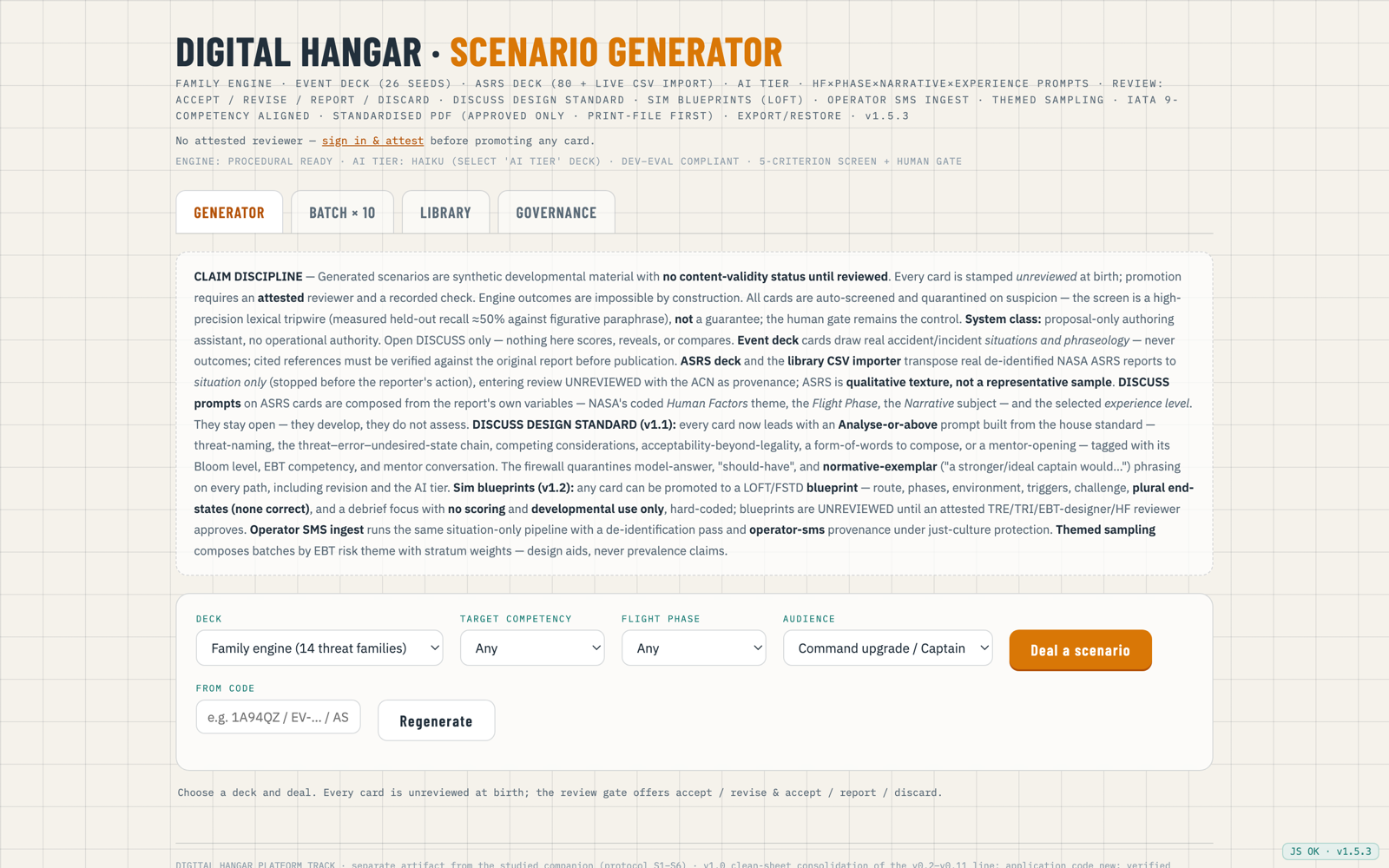
Claim discipline is built into the object rather than the documentation. Generated scenarios are synthetic developmental material with no content-validity status until reviewed; every card is stamped unreviewed at birth, and promotion requires an attested reviewer and a recorded check. Cards are auto-screened and quarantined on suspicion, with the screen described as a high-precision lexical tripwire of roughly fifty per cent measured held-out recall against figurative paraphrase — explicitly not a guarantee, with the human gate remaining the control. Only approved cards reach the standardised PDF export.
Status: v1.5.3, in development.
Digital Hangar — the generator tab, with the claim-discipline statement above the deck, competency, phase and audience controls. Select to view full size.
In development
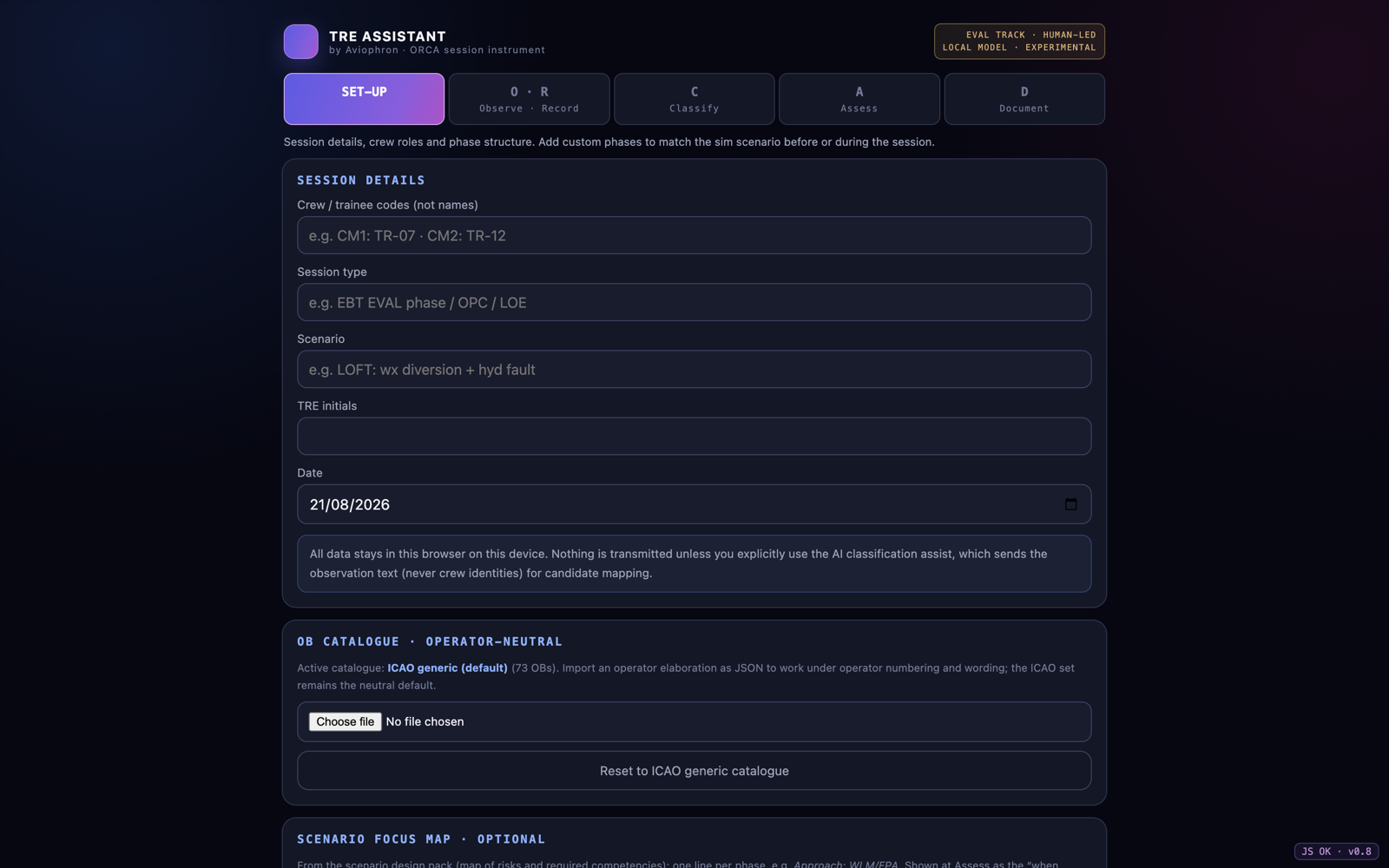
TRE Assistant — an ORCA session instrument
A session instrument for type rating examiners, following the EASA ORCA methodology — observe, record, classify, assess — with grading deliberately deferred to the end of the process in line with GM2 ORO.FC.231. The observable behaviour catalogue is treated as a classification reference and never as a checklist: the ICAO generic set of seventy-three observable behaviours is the neutral default, and operator elaborations can be imported to work under an operator's own numbering and wording. Per-observation root cause preparation runs through TEM and HFACS 8.0.
The instrument is positioned as human-led evidence organisation with an experimental advisory layer. That layer is not validated semantics and has no published accuracy; topic anchors are transparent lexical keyword matches that carry no polarity and no semantic claim, they prefill rather than link, and they appear only at the classification step and never during recording. Session data stays in the browser on the examiner's own device, and the instrument runs against a local model.
Status: v0.8, evaluation track, experimental.
TRE Assistant — session set-up, showing the ORCA step sequence and the operator-neutral observable behaviour catalogue. Select to view full size.
Sextant and Causalis were selected in the top ten of the EASA AI Olympics 2026.